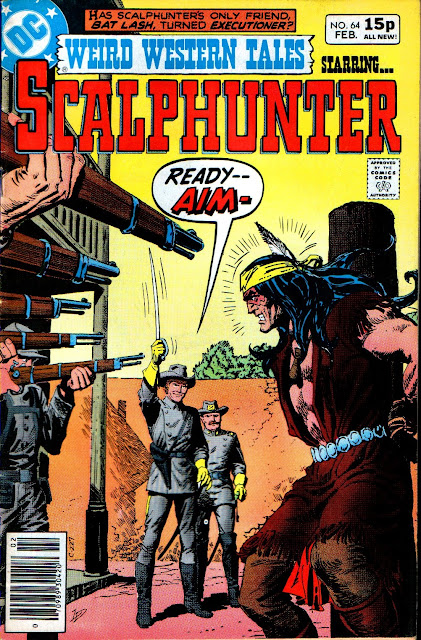
WESTERN COMICS
Aficionados of the art of Western art displayed on
paperback and pulp covers have long known the axiom regarding the cover art
being the sizzle that sells the substance of the Western stories inside. For
the Western pulps of the ‘30s and ‘40s, a brightly colored, action filled,
cover—and a few black and white line drawing accompanying the stories
inside—was the extent of the art each issue had to offer. For the paperback
original Westerns, art only extended to the front cover and perhaps another
illustration on the back. However, it is undeniable how important cover art was
to the sales of the Western pulps and paperbacks. The appreciation of cover art
is also a big reason why these items remain popular with collectors. However,
there was another form of Western storytelling which relied on the skill of the
illustrator as much as the stories from the wordslingers—Western comic books.

Stories of six-gun justice have been hungrily devoured by a
near insatiable audience since the first frontiersmen and women opened the Wild
West. Every gunslick, cowpuncher, tin star, wagon train, cattle drive, and
owlhoot who followed only added more to the menu. At the peak of their
popularity—the late ‘30s through the ‘60s— Western related pulps, paperbacks,
and newspaper comic strips had a massive readership.
Syndicated Western comics strips first appeared in
newspapers in the late 1920s. United Features Syndicate introduced Young
Buffalo Bill in 1928. Red Ryder, Little Joe, and King of the
Royal Mounted hit the dailies in the 1930s and were syndicated in hundreds
of newspapers. In 1937, Centaur Publications released the first stand-alone
Western comics—Star Ranger and Western Picture Stories. These
paved the way for the over 250 Western comics—series and one shots—to come.
The real explosion of Western comics, however, began with
the end of World War II. All the major comic publishers launched their own
Western comic books, which entertained eager readers for the next several
decades.
Real life Western movie stars such as Roy Rogers, Gene
Autry, Rex Allen, Lash Larue, Rocky Lane, Bill Elliot, Johnny Mack Brown, Rod
Cameron, Tim Holt, Ken Maynard, Buffalo Bill Jr., Bill Boyd, Tom Mix, and many
others—some still remembered, others now obscure—parlayed their popularity into
Western celebrity comics. Photos of the stars in their Western regalia (often
sporting six-shooters or hugging their horse) were splashed in full color
across the covers.

The illustrated storytelling inside the Western celebrity
comics, however, was largely sub-par. These Western celebrity comics were aimed
at kids who idolized the celluloid singing and shooting cowboys who appeared on
the covers, and who they watched during Saturday matinees at the movies. As a
result, many a parent was badgered into parting with the nickel or dime needed
to ransom these comics from drug store spinner racks. Comic publishers knew
Western celebrity comics would sell based on the covers alone, so spending
time, effort, and—more importantly—money worrying about the interior art and
storytelling was a waste.
With the rise of television, Western celebrity comics
morphed into comics tied to popular television shows. Have Gun Will Travel,
Wanted: Dead or Alive, Rawhide, Laramie, Laredo, Wyatt Earp, Bat Masterson,
Bonanza, The Rifleman, Colt 45, Lawman, Maverick, Cheyenne, Zorro, and many
of the other popular Western TV shows of the ‘50s and ‘60s struck merchandizing
deals—most often with Dell Comics or Gold Key Comics—to keep viewer interest
high. Western movies (especially those starring John Wayne) were also
transitioned into Western tie-in comics. The Searchers, El Dorado, War Wagon,
and other major Western films all received the comic treatment.


As with the Western celebrity comics, the Western TV and
movie tie-in comics all took advantage of full color publicity stills for their
eye-catching covers. But, the interior art beneath the covers—while mostly
static and unimaginative—was a major step up from their forbearers. The comic
likenesses of the actors who stared in the TV Westerns and movies was often
suspect, but always had enough of an identifiable resemblance for a reader to
recognize their heroes.


Marvel Comics was one of the first and definitely largest
publisher to recognize the growing adult readership for comics after WWII. The
popularity of superheroes was on the wane, so Marvel turned to original Western
comics to capture this more sophisticated audience. Marvel rapidly became the
most prolific publisher of original Western comics—starting with Kid Colt
Outlaw in 1948. The popularity of Kid Colt Outlaw spurred Marvel to
initiate many other long running Western comics—including Rawhide Kid, Two-Gun
Kid, and Wild Western.
The latter title was created by Stan Lee and was home to the
first appearances of Kid Colt, Two-Gun Kid and Arizona Annie. Lee also
created both the Rawhide Kid and the Two Gun Kid for Marvel.
Originally appearing in 1955, Rawhide Kid was a heroic gunslinger who is
unjustly hunted as an outlaw. Two-Gun Kid, the alter-ego of cowpuncher
Clay Harder, premiered in 1948.
Two-Gun Kid was Marvel's second continuing Western
character, following The Masked Raider. In 1962, Stan Lee and Jack Kirby
sought to revitalize the character. They turned Clay Harder into a dime novel
hero who inspired their latest hero, vigilante Matt Hawk, to become the Two-Gun
Kid. Lee and Kirby accomplished the reimagining of the character as a
superhero with a secret identity, in order to stimulate sales.
DC got into Western comics with the long-running series All-Star
Western and Western Comics. Other publishers such as Charlton
Comics, Dell Comics, and Fawcett Comics contributed many other popular titles,
such as Billy the Kid, Cheyenne Kid, Outlaws of the West, Texas Rangers in
Action, The Lone Ranger, Hopalong Cassidy, and Black Fury—a horse roaming
the West righting wrongs. Western comics were also created starring Jesse
James, Wild Bill Hickok, and other Western historical figures.
With the continuing popularity of Western comics, Marvel
turned loose Black Rider and Phantom Rider in their own comics.
DC kept pace with such Western characters as Johnny Thunder, Nighthawk, Pow
Wow Smith, Tomahawk, The Trigger Twins, and Vigilante. In 1965, Dell Comics
debuted the Western comic Lobo, which featured the first
African-American character to headline his own series (it lasted for only two
issues).
Western characters whose names began or ended with Kid were
legion. There was Kid Colt, Rawhide Kid, Ringo Kid, Two-Gun Kid, Outlaw Kid,
Kid Cody, Western Kid, Prairie Kid, Arizona Kid, Apache Kid, Texas Kid,
Chinatown Kid, Wyoming Kid, Billy the Kid, Cheyenne Kid, Cisco Kid, Durango Kid,
and enough others to tame the Wild West ten times over.
While Western comic titles proliferated, the quality of the
writing and the art varied as wildly as the characters they depicted. However,
since Western Comics were such a popular genre in the 1950s, many of the of the
illustrators and wordslingers who contributed to their pages would go on to
receive great recognition—even adulation.


These are a few of the greats who showed of their talents in
many of the Western comics: Early Western comics Star Ranger and Western
Picture Stories featured the art of the legendary Will Eisner. Fawcett
Comics’ Tom Mix gave tenure to longtime artist Carl Pfeufer. Over eleven
years, writer Paul S. Newman and artist Tom Gill collaborated on 107 issues of
Dell's The Lone Ranger. Writer and illustrator Larry Lieber handled
Marvel's Rawhide Kid for nine years. DC's Tomahawk displayed the
talents of writer France Herron and illustrator Fred Ray over many issues. And
Gaylord DuBois handed the writing chores for the entire run of The Lone
Ranger's Famous Horse Hi-Yo Silver.


The Durango Kid had a long run with artist Fred
Guardineer. Most of Kid Colt's early stories were illustrated by Pete
Tumlinson, who would go on to handle he artistic chores for Outlaw Fighters, Two-Gun Western, and
Wild Western. Mike Sekowsky illustrated The Apache Kid, The Black Rider,
and Kid Colt, as well as the Gunsmoke and Buffalo Bill, Jr.
TV tie-ins. Wild Western, All Western Winners, Arizona Kid, Black Rider,
Western Outlaws, and Reno Browne: Hollywood's Greatest Cowgirl were all roped
and tied by Russ Heath.
From cowboy celebrities to movie cowboy heroes and TV
westerns, to the many characters who originated in the four-color version of
the Wild West, Western comics had a long and gloriously entertaining run. By
the late ‘60s, however, superheroes, horror, and science fiction comics were
the new reader darlings, pushing Western comics to the fringes. By the late
‘70s even the most popular and long running Western comics had been gunned
down.
There have been mildly successful attempts over the decades
to resurrect Western comics, but their success has never been sustained.
However, a spin-off from the Western genre known as Weird Westerns—which blend
tales of the West with the supernatural, vampires, werewolves, and various
other haunts and monsters—has enjoyed limited success riding the range and
bringing readers back to the form.